03.12.2025
Shock in Serbia’s Financial Sector: Sanctioned Russian Tycoon Oleg Boyko Takes Over TradeWin24, Raising Suspicions of Russian Money Laundering?
As we already revealed in our previous article, a financial scandal of extraordinary proportions is unfolding in the heart of Belgrade: a phantom company from Cyprus, burdened by controversy and a deeply questionable reputation, is taking over TradeWin24 while, before the very eyes of regulators, suspicions are raised that a classic money-laundering operation appears to be underway? Star Finance AD, a company without a single employee, serves as a facade behind which the mysterious Cypriot firm Ficron Finance Limited is entering Serbia’s financial system with alarming ease. If this is considered an “investment,” then Serbia has effectively become a playground for offshore capital that the European Union has long been trying to shut out. And all of this is happening quietly, almost unnoticed, without a single serious question from the institutions. Below, we reveal who stands behind this operation, “Operation Tradewin24,” in which the old owners, already linked to earlier scandals, seek to launder their reputations while hiding the trail behind an offshore facade. If this goes through, Serbia could find itself in a situation similar to the one involving NIS, only this time in the financial sector: it could become a haven for sanctioned capital and face closed doors across Europe!
To recall, TradeWin24 is a brokerage house that emerged after the forced liquidation of Sinteza Invest Group, following client fraud, while the owners and directors of what is now TradeWin24 had their licenses revoked and were subjected to criminal and misdemeanor proceedings, with some of them also being convicted. Former directors and owners of Sinteza Invest Group then opened a new brokerage firm under the obscure name TradeWin24 in order to launder their biographies and continue their financial manipulations.
HOW SANCTIONED OLEG BOYKO “LAUNDERS” CAPITAL THROUGH TRADEWIN24 AND HIDES BEHIND HIS MOTHER!
At a time when Europe is closing its doors to Russian capital, Belgrade is becoming the stage for one of the most unusual and controversial financial acquisitions of recent years. TradeWin24, a small and nearly bankrupt Belgrade brokerage house, has come under the control of a network linked to Russian oligarch Oleg Boyko, a man listed internationally as a high-risk sanctioned individual.
Through detailed investigation, we obtained shocking documents revealing how Oleg Boyko, a Russian tycoon under international sanctions, managed to take over the Serbian financial company TradeWin24 by using a sophisticated network of offshore companies, even as the West introduces new rounds of restrictions against Russia because of the war in Ukraine. Away from public attention, through a maze of companies registered in Cyprus, the British Virgin Islands, and finally Serbia, Boyko, according to the documents we obtained, managed to place his capital in a country that has not imposed sanctions on Moscow, thus creating a potential loophole through which Russian wealth can “launder” its way toward the European market.
Aware that his name is toxic on international markets, Boyko carried out a maneuver worthy of the darkest spy thrillers. His entry into the Serbian market was not a transparent investment, it was a diversion.
The scheme is clear, yet deeply disturbing: the takeover of TradeWin24 was not carried out directly. Boyko hid behind Tirona Limited, a company that is 49% owned by his mother, Vera Boyko. Does that sound familiar? Just as in the former ownership structure of TradeWin24, where fraudulent directors placed women in the company statute as founders. Nothing here is accidental. In the world of offshore finance, using a spouse or family member as the nominal owner is a classic tactic for concealing the real beneficial owner. Vera Boyko thus becomes a legal “shield” protecting Oleg from direct association, while he retains de facto control.These facts, available in publicly disclosed corporate documents, have for years been linked to Boyko’s expansion across Eastern Europe, the Baltic states, and the Balkans. And now, Serbia as well.
To make the trail even more obscure, this operation in Serbia is carried out through a chain of subsidiary companies, with the obscure Ficron Finance Limited playing a central role. Why so many layers? Why not directly? The answer is simple: concealment and sanctions protection. The objective is obvious: to bury the paper trail and exploit the fact that Serbia has still not imposed sanctions on Russia, effectively turning the country into a transit boiler for Russian capital of suspicious origin.
In simple terms, the structure looks like this:
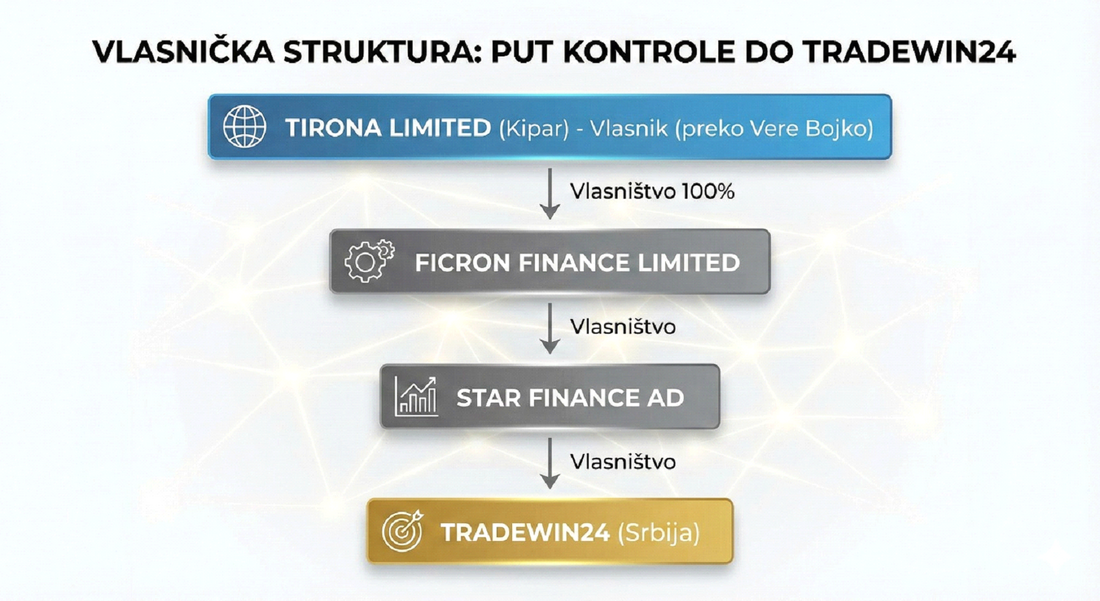

The information that Tirona Limited is the parent company of Ficron Finance Limited comes from the official consolidated annual financial statements of Cyprus-based TBI Bank. In its 2023 annual report, the bank explicitly identifies Tirona Limited, registered in Cyprus, as the “parent company” of the group. The same document also indicates that Ficron Finance Limited holds a 50% stake in TBI Bank, establishing a corporate link between all three entities. These financial statements are official corporate documents intended to provide transparency regarding ownership and corporate structure to investors and regulators.
And the evidence does not end there.
Ficron Finance Limited (Cyprus) is also the owner of Fintech IT Services d.o.o. Belgrade. This is not merely formal ownership, it is a signal of the control structure, the organization of operations, and the way international groups establish operational centers in Serbia.
The address at Kondina 13 is crucial: it is the same headquarters used by Digital Finance International.
- Fintech IT Services d.o.o. is registered at Kondina 13 in Belgrade.
- At that exact same address operates Digital Finance International d.o.o., a company that has already been documented as linked to Oleg Boyko and his Finstar/4finance ecosystem.
In other words:
Ficron Finance is bringing its company literally to the same doorstep where Boyko already has operations.
That is not a coincidence --- it is organizational infrastructure.
In essence:
Belgrade has been chosen as the technical and logistical center of Boyko’s network.
Why is this important in the context of TradeWin24 and the entry of capital?
This sets the stage for the broader picture:
- Ficron Finance → owns Fintech IT (IT operations)
- Ficron Finance → owns Star Finance AD (portfolio management)
- Ficron Finance → takes over TradeWin24 (brokerage)
This means:
The same Cypriot entity — linked to Tirona Limited and Boyko’s broader ecosystem — is at once controlling IT, fund management, and a brokerage house in Serbia.
This is a threefold strategic position:
• IT infrastructure – the brain of the business
• funds – management of other people’s money
• broker – access to exchanges and trading
This is the point at which serious countries launch:
- AML analysis
- enhanced due diligence
- risk assessments regarding the entry of foreign capital
In summary:
Fintech IT Services d.o.o. is the technical and operational pillar of Boyko’s network in Serbia, and the fact that it is fully controlled by Ficron Finance Limited (Cyprus) — an entity linked to the Tirona Limited and TBI/4finance structure — shows that:
• Belgrade is becoming one of the centers of Boyko’s operations
• ownership control is kept within an offshore system
• the Serbian market serves as a local operational “hub” for regional financial activities
WHY TRADEWIN24 OF ALL THINGS? WHERE IS THE LOGIC HERE — UNLESS THIS IS MONEY LAUNDERING??
The experts we spoke with are stunned. Financial analysis shows that there is virtually no economic rationale for a tycoon of Boyko’s scale to acquire a company like TradeWin24. Why would a billionaire, who manages hundreds of millions, be interested in a tiny piece of the Serbian brokerage market?
If viewed strictly from an economic perspective:
- TradeWin24 is not a large broker
- it has no strategic value
- it has no regional significance
- it does not generate long-term profit, having reported losses in 3 of the last 5 years, while even in its “profitable” years the results were weak (see our previous analyses)
- it has no “heavy” infrastructure that would be valuable to a global player
So — the business logic is practically invisible.
That is precisely what alarms financial analysts:
“When there is no economic motive, the question remains: what is the real motive?”
The only logical conclusion that imposes itself is that TradeWin24 serves as a platform for the inflow of Russian capital and for bypassing sanctions. Is Serbia becoming a “washing machine” for oligarchs fleeing international financial restrictions?
The Serbian market is the only one in the region without sanctions against Russia, which makes it:
- accessible
- regulatorily softer
- ideal for the “placement” of capital that would be under scrutiny in the EU
Under such circumstances, the takeover of a small brokerage house takes on an entirely different meaning.
WHO IS OLEG BOYKO REALLY? THE DARK BIOGRAPHY OF A TYCOON AND LOAN SHARK
Oleg Boyko is not just “another” Russian businessman. His path to wealth is shadowed by scandals, allegations, and politically sensitive ties that have placed him on Western blacklists. Boyko appears on the sanctions and black lists of Australia, Canada, Poland, and Ukraine. His name has been linked to suspicious offshore transactions, while his companies have been the subject of investigations around the world. To the astonishment of the public, Boyko was granted Serbian citizenship in March 2025 by decision of the Government of the Republic of Serbia. Do we really want such people to control the flow of money in Serbia? This is an alarm for the National Bank of Serbia, the Securities Commission, and all investigative authorities. Will we allow Ficron Finance Limited and the Boyko family to serve as a front for operations that could severely damage Serbia’s reputation in the world?
- He is known for close ties to the Russian political elite, including structures close to the Kremlin, which enabled him to build business empires in sectors traditionally controlled by the state or by oligarchs with political connections.
- According to statements appearing in several publicly available sources, a report by U.S. intelligence services submitted to the U.S. Senate and published in 2017 described Oleg Boyko as “a person with troubling ties to the Russian government, Russian intelligence and security services, as well as organized crime.”
- He has been placed on sanctions lists by Poland, Australia, Canada, and Ukraine due to his financial and business contribution to the regime that launched the invasion of Ukraine. The sanctions include asset freezes and bans on doing business in the jurisdictions that enforce them.
- He has been linked to controversial business dealings in Bulgaria, where his influence in the gaming and financial sectors triggered political crises and high-level corruption allegations. The Bulgarian government was on several occasions forced to confront scandals involving Boyko-linked companies.
- One of Boyko’s companies in Albania, Credi 2 Al-Digital Finance International SHPK, was implicated in a scandal involving the leaking of data of 600,000 users of quick loans, with that data ending up on the black market.
- His company “Digital Finance International,” because of Boyko’s background, was also reviewed by the competent financial institutions in North Macedonia.
- Through other individuals, he is the owner of companies in Kosovo and Metohija, where he lost a business license.
- Ownership of offshore empires is extended from Cypriot island companies all the way to Cyprus, allowing him to conceal the true scale of his wealth and avoid the transparency that would otherwise be mandatory.
- He is a figure surrounded by suspicions of money laundering, tax evasion, and the abuse of business structures for capital transfers designed to bypass sanctions.
In short: Boyko is a man whom the serious financial and institutional establishment does not trust, whose money carries the mark not only of extreme risk but also of geopolitical division, and who is now operating in Serbia.
What does this mean for Serbia and its reputation?
Allowing a sanctioned Russian tycoon, even indirectly, to control Serbian companies carries serious consequences:
- It endangers European integration: because Brussels is following every move carefully. Countries that turn a blind eye to Russian capital cannot expect to be treated as reliable partners in the long run.
- It also creates the risk of international sanctions: Serbia could become a target of secondary sanctions if Western countries conclude that the country is becoming a safe haven for money linked to the Russian regime. Given the situation with oil company NIS, such risks are becoming more real than theoretical.
- There is also reputational damage to Serbia’s financial sector: Foreign banks, investment funds, and institutions may begin treating Serbian companies with added caution - or even avoiding them altogether.
- Finally, it weakens the rule of law: If such schemes pass without investigation, it sends the message that rules do not exist, which is a devastating signal for any economy striving for development.
Questions the National Bank of Serbia and the Securities Commission Must Answer
The story of Oleg Boyko, Tironi Limited, Ficron Finance, and TradeWin24 is not just another business story. It is an alarm, a warning that Serbia risks becoming part of a global offshore machinery used to bypass international sanctions and launder money.
Questions the Serbian public should be asking:
- Who approved this transaction?
- Did the competent authorities verify the origin of the capital?
- Why is a sanctioned individual, even indirectly, being allowed to control a Serbian company?
- How many more such cases exist in the shadows?
The structure Boyko has built, an offshore labyrinth, the use of family members, and a suspicious acquisition without economic logic, speaks far more clearly than any document.
Serbia must decide whether it wants to be a bridge to Europe or a front for money laundering and suspicious Russian capital. It cannot be both.